A Letter That Found the Right Reader
In 1911, Booker T. Washington, principal of Tuskegee Institute in Alabama, was already the most prominent Black educator in the United States. Julius Rosenwald, who had become president of Sears, Roebuck and Company in 1908, was among the wealthiest men in Chicago. The two had exchanged letters before a face-to-face meeting materialized, and Washington was deliberate about what he sent Rosenwald to read: a copy of Robert Russa Moton's account of rural Black schooling in the South, and documentation of the small, experimental schools Tuskegee had begun funding in Macon County, Alabama. Washington understood that Rosenwald responded to evidence.
The meeting came in 1912, when Rosenwald visited Tuskegee. What Washington showed him was not an appeal but a working model: six small schoolhouses already built in the county, each one the product of contributions from local Black families, matching funds from white landowners, and a modest grant from Tuskegee itself. The three-way structure was already embedded in the design before Rosenwald arrived. Washington was not asking him to invent a programme; he was asking him to scale one that already functioned.

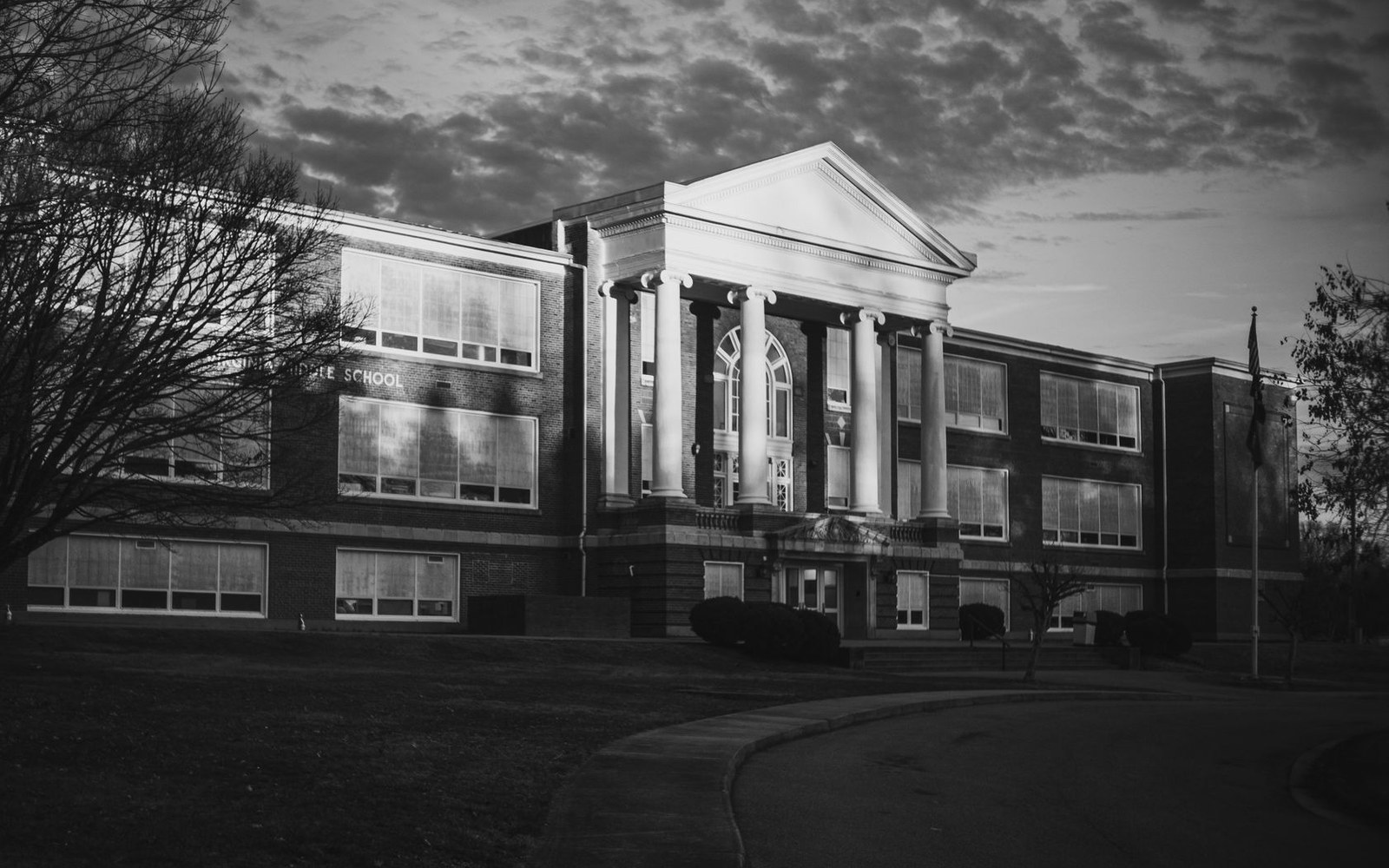
A surviving Rosenwald school, showing the full run of windows on the long elevation.
Photo: Fra 890 / Pexels
The Matching-Grant Architecture
The logic Washington had developed was precise and deliberate. A community that could not afford a school on its own could afford it if the burden were divided. Local Black residents contributed cash, land, or labour. Local white philanthropists or county governments added a share. An outside grant — from Tuskegee at first, then from the Rosenwald Fund after its formal establishment in 1917 — completed the triangle. No single party carried the full cost, and no school was built without a demonstrated local commitment. That last condition mattered enormously to Washington: it made the community a stakeholder rather than a recipient.
Rosenwald's initial gift in 1912 funded six additional schoolhouses in Macon County, bringing the county total to twelve. The results were documented in Tuskegee's own records, and the model held. Buildings went up. Enrolment followed. Rosenwald extended his support, and by the time Washington died in 1915, the programme had reached across several Alabama counties and into neighbouring states.
After Washington
Washington did not live to see the full reach of what he had structured. When the Julius Rosenwald Fund was formally chartered in 1917 under Illinois law, the school-building programme became its centrepiece. Samuel L. Smith, hired as director of the Fund's rural school programme, standardised the architectural plans and the accounting procedures, producing a system that could be administered county by county across the South. The Fund published its own building guides, specifying window placement, ventilation, classroom dimensions, and construction materials — details still visible in surviving Rosenwald schools documented by the National Trust for Historic Preservation.
Between 1917 and 1932, when the building programme ended, the Fund contributed to the construction of 4,977 schools, shops, and teachers' homes across fifteen Southern states. The communities themselves — Black families who in many cases were already paying local taxes that funded white schools — raised more than four million dollars of their own money toward the effort. County and state governments contributed additional public funds, a political achievement that Washington had anticipated: by requiring government participation, the matching structure pulled public money toward Black education that would not otherwise have moved.
Washington, principal of Tuskegee Institute in Alabama, was already the most prominent Black educator in the United States.
The correspondence between Washington and Rosenwald, preserved in the Booker T. Washington Papers at the Library of Congress, shows two men negotiating across very different positions of social power toward a shared practical end. Washington's genius was in designing a mechanism that Rosenwald's money could enter without displacing local ownership. The result was not charity in the conventional sense but a lever — one that moved public institutions by attaching private capital to community action.
Nearly five thousand schools is a number that belongs, finally, to the communities that built them as much as to the two men whose 1912 meeting started the counting.