An Acre of Policy
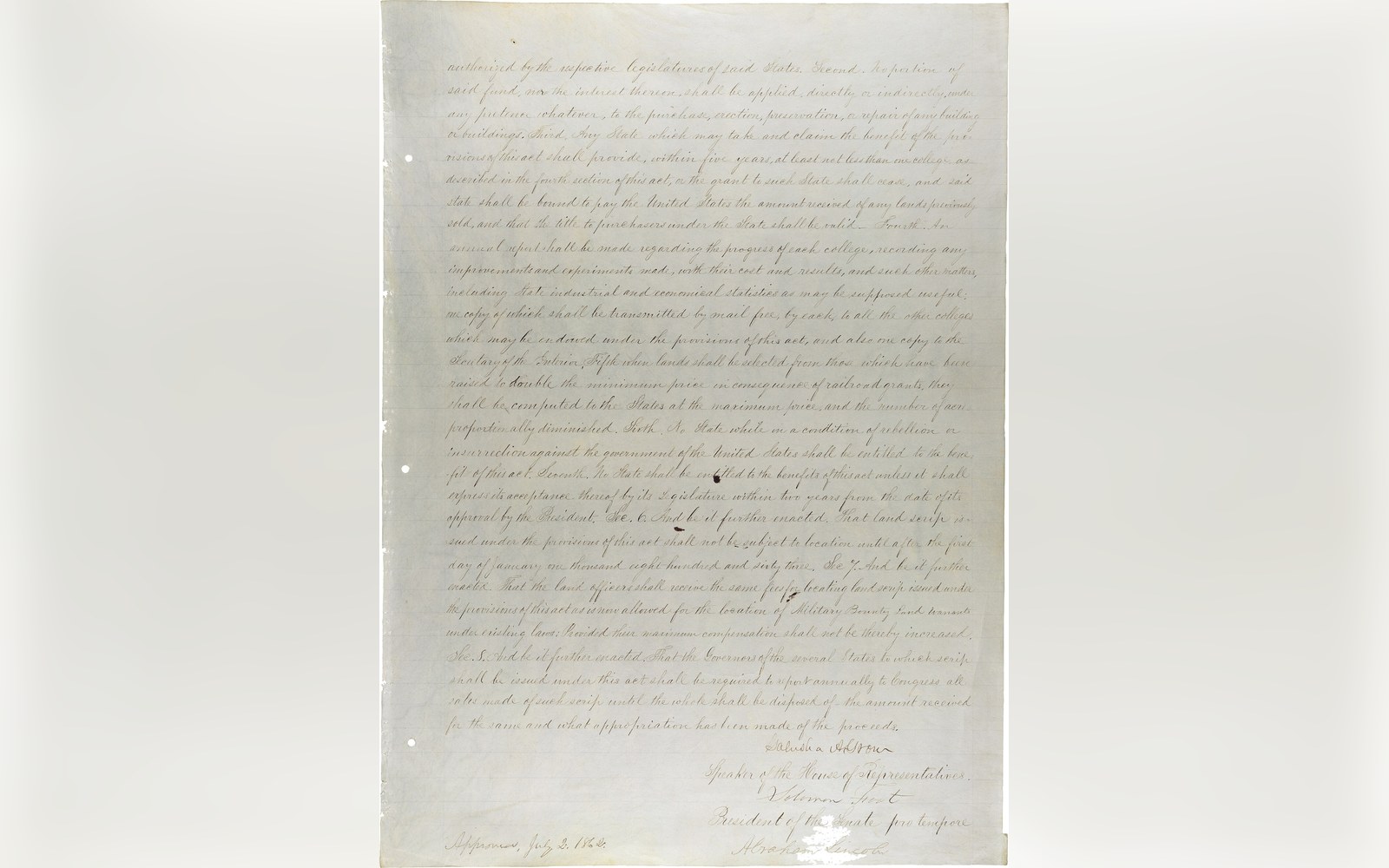
When Justin Smith Morrill of Vermont first introduced his land-grant college bill in 1857, Congress passed it — and President Buchanan vetoed it. Five years later, with the Southern states out of the Union and the political calculus entirely changed, Abraham Lincoln signed the Morrill Act into law on July 2, 1862. The mechanism was straightforward and consequential: each loyal state received scrip entitling it to 30,000 acres of federal land for every senator and representative it held in Congress. States without sufficient public land within their borders could claim acreage in the western territories. The proceeds from selling that land were to endow colleges teaching agriculture and the mechanic arts — practical sciences, not the classical curriculum that dominated American higher education at the time.
The total land transferred under the first Morrill Act reached roughly 17.4 million acres, a figure recorded across dozens of state grants. What states did with the scrip varied considerably. Some sold quickly and at low prices, leaving their endowments thin from the start. Others held longer and built more durable foundations. Cornell University in New York, chartered in 1865, became one of the early examples of an institution that used the grant to construct something nationally significant. The act did not build colleges directly; it created a funding mechanism and left architecture, curriculum, and governance entirely to the states.

Opened 1927, a National Historic Site since 1998. The building is the document.
Photo: Facade of Central High School - Little Rock - Arkansas - USA - 01 · Wikimedia Commons
What 1890 Required
The second Morrill Act, signed on August 30, 1890, addressed what the first had left untouched: the former Confederate states. Readmitted to the Union but operating racially segregated systems, those states had used their 1862 grants to fund institutions that excluded Black students entirely. The 1890 act introduced a direct condition: no state with a racially segregated system could receive the new annual appropriation unless it provided, equitably, for a college serving Black students. This clause produced the historically Black colleges and universities now grouped under the designation "1890 institutions" — among them Alcorn State University in Mississippi (which had existed since 1871 and was formally designated under the new act), Tuskegee University in Alabama, Florida A&M University, and Prairie View A&M in Texas.
The word "equitably" carried almost no enforcement weight in practice. Southern legislatures consistently directed far larger shares of the combined federal and state appropriation to the white institutions. The gap between what the 1890 colleges were promised and what they received persisted well into the twentieth century, documented in congressional hearings and later in federal compliance reviews. Still, the act created institutions that would otherwise not have existed, and those colleges educated generations of Black professionals — teachers, engineers, physicians, and farmers — who had no access to the white land-grant schools.
Booker T. Washington's Tuskegee Institute occupied an important position in this landscape, emphasizing exactly the agricultural and mechanical training the Morrill Acts nominally promoted, while W. E. B. Du Bois argued that the curriculum offered to Black students was being deliberately narrowed in ways it was not for white students. That argument moved on a different plane from the land-grant mechanism itself, but it clarified what the mechanism's inequity meant in human terms.
The Colleges That Remain
More than a hundred and fifty years after the first act, the land-grant system comprises over a hundred institutions across every state and several territories, catalogued by the National Institute of Food and Agriculture. The University of Wisconsin, Iowa State, Michigan State, and dozens of others trace their legal origin to the 1862 grant. The 1890 institutions remain a distinct and federally recognized category. What began as a transaction in federal land scrip became, over time, the broadest single act of institution-building in the history of American public higher education.