The Ordinance and Its Clause
When the Confederation Congress enacted the Northwest Ordinance on July 13, 1787, it did more than establish a framework for governing the territory north of the Ohio River. Article III of that document declared, in plain terms, that religion, morality, and knowledge being necessary to good government and the happiness of mankind, schools and the means of education shall forever be encouraged. The words were aspirational; the mechanism that followed was concrete.
Federal land surveyors had already begun imposing a grid on the Northwest Territory. Under the Land Ordinance of 1785, the territory was divided into townships of six miles square, each township subdivided into thirty-six numbered sections of 640 acres apiece. The Land Ordinance completed the logic of that grid by reserving section sixteen of every township — the parcel occupying the third row, third column of the standard plat — for the maintenance of public schools within the township. The federal government, in other words, attached an educational endowment to the landscape before settlers arrived to build anything on it.
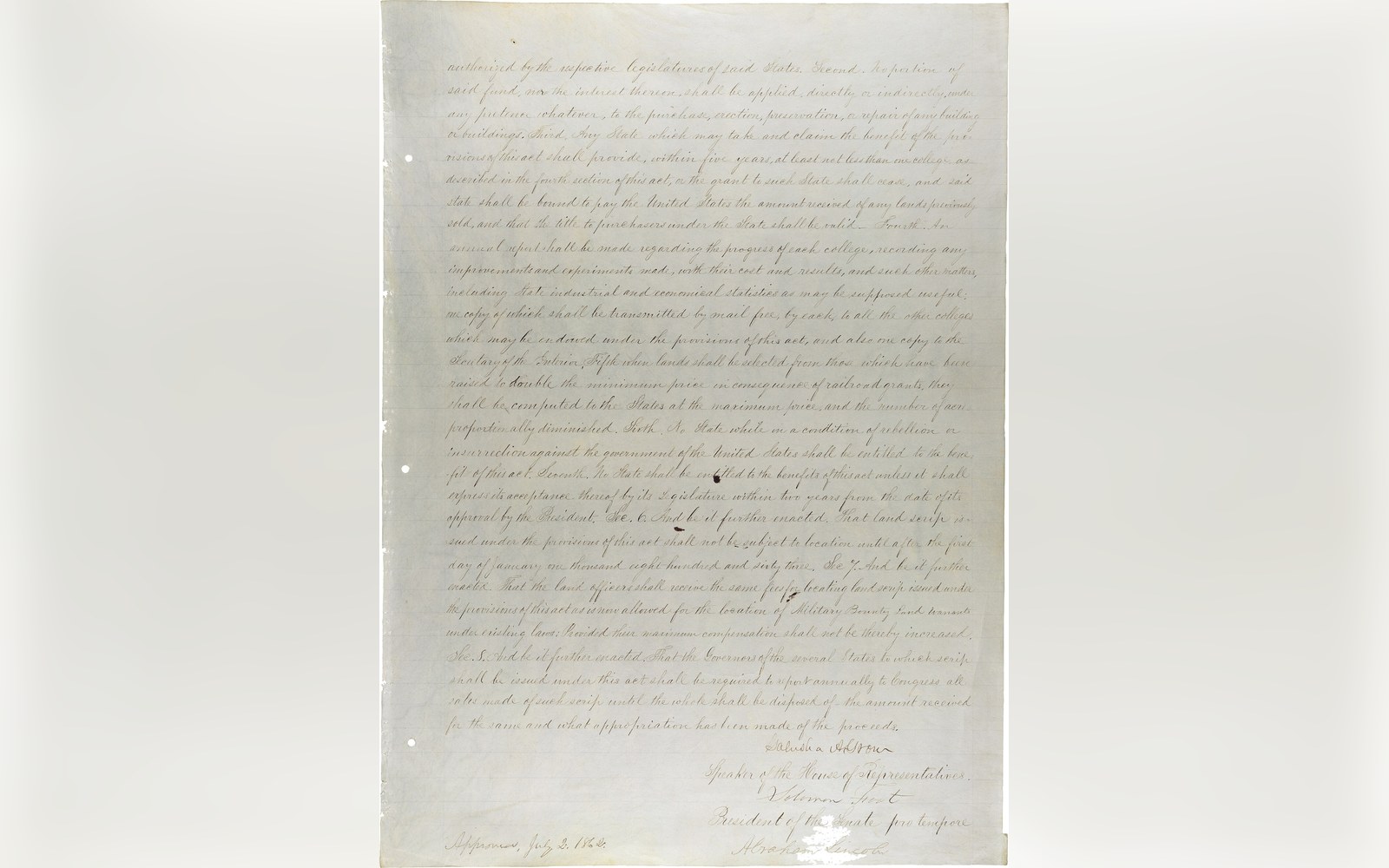
The enrolled Act, signed July 1862.
Photo: Morrill Act - Last Page · Wikimedia Commons
What Section Sixteen Actually Did
The section-sixteen mechanism was not a spending programme. Congress did not appropriate money; it withheld a piece of real estate from sale and assigned its benefit to local schooling. Territorial and, later, state governments were expected to lease or sell the section and apply the proceeds to school support. In practice, outcomes varied widely. Some states managed their school lands prudently and accumulated lasting endowments; others sold section-sixteen parcels quickly and at low prices, dissipating the capital before school systems were mature enough to use it.
Ohio, admitted to the Union in 1803 as the first state carved from the Northwest Territory, received its section-sixteen grants under this framework. The principle then travelled with every new state admitted from federal territory, eventually extending well beyond the original Northwest — into the Deep South, across the Great Plains, and into the Far West. By the mid-nineteenth century, section sixteen (and, in later enabling acts, section thirty-six as a supplement) had become standard furniture in the enabling legislation that converted federal territory into a state.
The mechanism carried an important ideological weight alongside its practical one. It established, at the republic's founding moment, that public education was a federal concern, not merely a local charity. No earlier act of the Continental Congress had tied land distribution to schooling so explicitly. The Ordinance did not mandate a curriculum, a school building, or a teacher; it mandated a revenue source — land — and trusted states to build the institution around it.
The Downstream Line
The section-sixteen tradition fed directly into the land-grant college movement of the following century. When Representative Justin Smith Morrill of Vermont drafted what became the Morrill Act of 1862, he extended the same underlying logic: federal land scrip, assigned to each state, to be converted into capital for institutions teaching agriculture and the mechanic arts. The constitutional reasoning that made section sixteen defensible in 1787 made the Morrill Act defensible in 1862. Both rested on the proposition that the federal government could promote education through its land assets without directly operating schools — a distinction that quieted constitutional objections to federal involvement in local schooling for nearly a century.
What the Northwest Ordinance established, then, was not a school. It was a habit of mind: that distributing land and endowing education were acts to be performed together, that a township without a school fund was an incomplete township. That habit shaped the physical landscape of American public education long before Horace Mann named the common school ideal, and long before the first schoolhouse was built on the western side of the Ohio River.