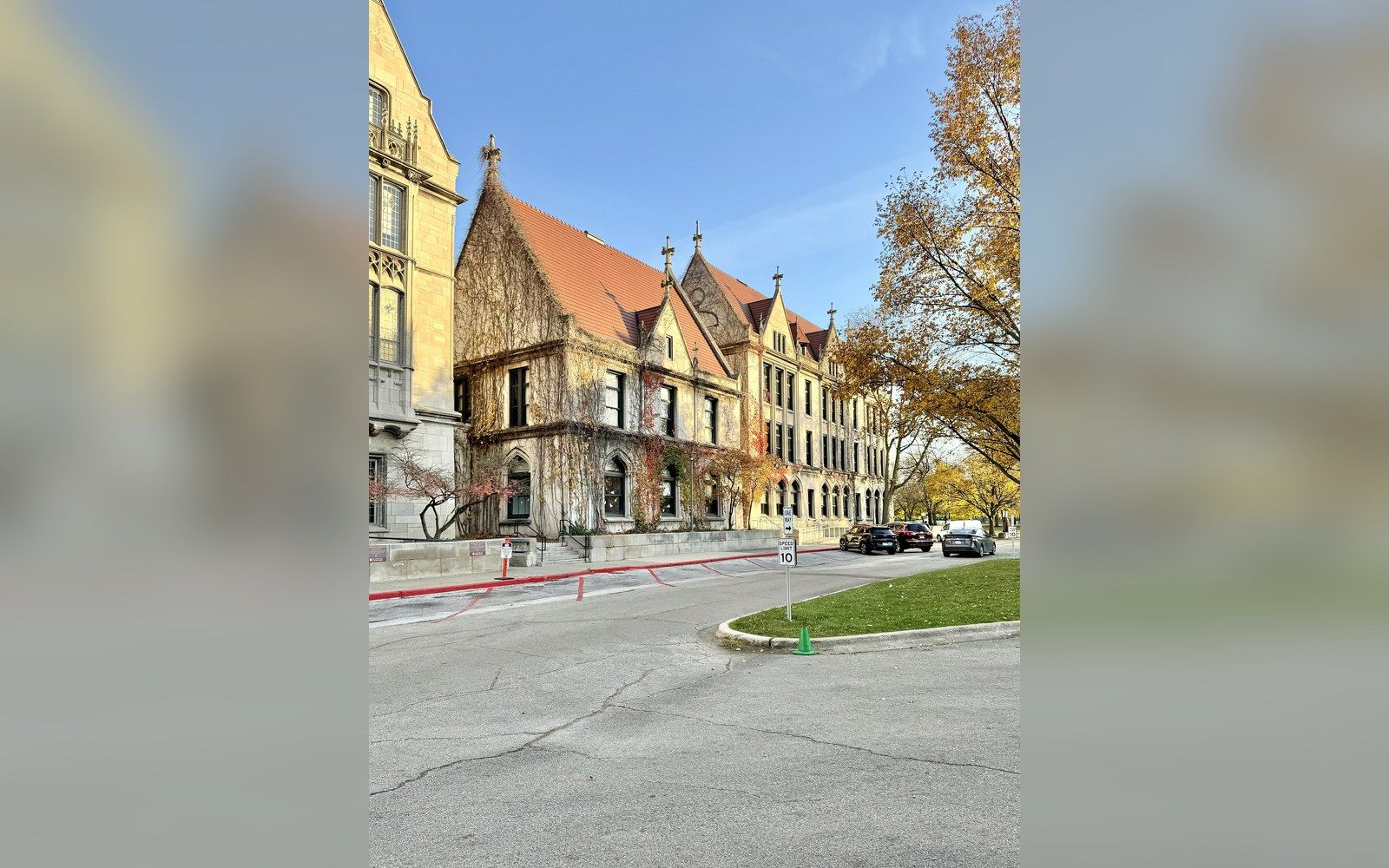
A School Built on a Proposition
When John Dewey opened the Laboratory School at the University of Chicago in January 1896, it occupied a rented house on the south side of the city and enrolled sixteen children. The name was deliberate. Dewey intended the school to function as a working hypothesis — a place where ideas about learning could be tested as rigorously as a chemistry experiment, and discarded if they failed.
The hypothesis was that children do not learn by sitting still and reciting back what a teacher has told them. The recitation bench was, in Dewey's view, not just an inefficient piece of furniture but a symbol of a mistaken theory of mind: that knowledge is something poured into a passive vessel. His alternative held that the mind grows through purposeful activity, and that the school's job was to supply activities worth growing by.

Slate and chalk outlasted every technology brought in to replace them.
Photo: NEOSiAM 18+ / Pexels
What the Curriculum Actually Looked Like
The Laboratory School's curriculum was organised around what Dewey called occupations — not vocational training in the narrow sense, but reconstructions of the productive work that had sustained human communities across history. Children cooked grain into food and, in doing so, encountered botany, chemistry, and the economics of agriculture. They wove cloth on hand looms and traced the industrial and cultural history of textile production. They worked with wood and metal, engaging geometry and physics through the resistance of real materials.
The kitchen was not a domestic-science annex. It was a primary site of instruction, chosen because cooking compressed an extraordinary range of intellectual content into a single, tangible process. A group of eight-year-olds preparing a meal was simultaneously doing measurement, learning the properties of heat, and working through a simplified version of the problems that human beings have solved for millennia. Dewey's reports to parents, collected and published while the school was still operating, described this method not as play but as disciplined inquiry made concrete.
Teachers at the school — Dewey's wife Alice was among the earliest and most significant — kept detailed records of what children did and said. Those records show children asking questions that moved fluidly between subject areas: why does bread rise, what is wheat, who grew it, where, and at what cost. The curriculum followed the question rather than the calendar.
The school grew steadily. By 1902 it had moved to purpose-built facilities and enrolled around one hundred and forty children, taught by a staff of twenty-three teachers and ten graduate assistants. That scale was itself an experiment: Dewey wanted to know whether the method survived the transition from a house to an institution.
What the School Produced
Dewey left the Laboratory School in 1904 after a dispute between Dewey and the university's administration over the merger of his school with a separate practice school; Dewey resigned his professorship and moved to Columbia University, where he spent the rest of his career. The school continued under other leadership, but the original experiment had run its course.
The hypothesis was that children do not learn by sitting still and reciting back what a teacher has told them.
What it left behind was less a curriculum than a set of questions that the progressive education movement carried forward for decades. Dewey's The School and Society (1899) and The Child and the Curriculum (1902), both written during the school's operation and drawing directly on its practice, became the most widely read statements of educational philosophy in twentieth-century America. School designers, including the architects of Crow Island School in Winnetka four decades later, cited Dewey's proposition — that the room should be shaped by the activity, not the other way around — as a founding premise.
The kitchen at the Laboratory School was not a metaphor. It was where the work happened, and that was precisely the point.