From Bowling Alley to Blackboard
The overhead projector's lineage runs through military training rather than pedagogy. Reflective overhead projection systems were developed during World War II for training large groups of personnel quickly; commercial versions appeared in bowling alleys and businesses before educators claimed the technology. By the mid-1950s, the U.S. Army was using overhead projectors extensively for instruction, and school administrators noticed. The 3M Company became the dominant manufacturer of classroom units by the early 1960s, and the machines spread steadily through American public schools across that decade, driven partly by the federal funding unlocked by the National Defense Education Act of 1958, which directed money toward instructional technology in the aftermath of Sputnik.
The Ritual the Machine Required
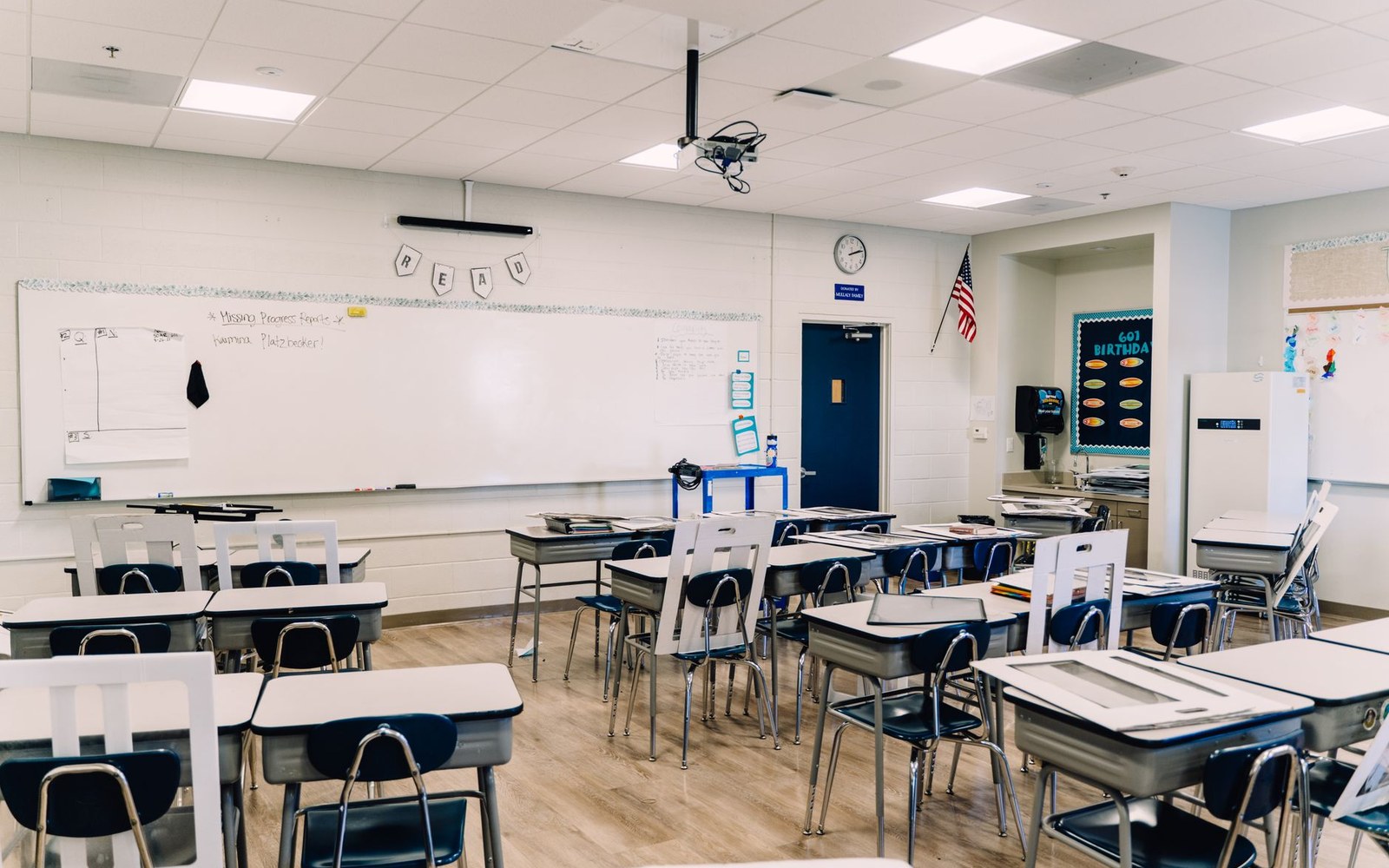
The projector sat on a rolling cart at the front of the room, aimed at a pull-down screen or a white wall. Its presence reorganised the spatial logic of the classroom: lights dimmed, seats angled toward the bright rectangle, and the teacher's body moved to the side rather than the centre. Three objects became standard pedagogical tools around it. The transparency — a sheet of clear acetate printed or hand-lettered with text and diagrams — could be prepared in advance and stacked in sequence, giving a lesson a visible architecture. The felt-tip overhead marker allowed a teacher to annotate a transparency in real time, underlining or circling while students copied. The blank acetate roll, mounted on a spindle at the top of the projector stage, let a teacher write continuously, advancing the roll to reveal fresh surface — a moving blackboard that left no chalk dust and could be rewound.

The Readers graduated from phonics to prose to rhetoric across six volumes.
Photo: Andrea Piacquadio / Pexels
These rituals shaped teacher preparation. Writing a transparency demanded that content be distilled to what fit legibly on an 8-by-10-inch sheet. The machine enforced economy in a way the blackboard did not.
By the 1990s, the liquid-crystal display panel placed on an overhead projector stage allowed computers to project onto the same screen. That transitional arrangement was itself short-lived; the dedicated digital projector rendered the overhead obsolete in most districts before 2005.