The seven days that painted a continent
Before that meeting, a school bus in Georgia might be painted red, one in Ohio blue, one in Maine a muddy brown. Drivers of those vehicles carried no uniform obligation, children at roadsides had no reliable signal to read, and the manufacturers building the coaches — hundreds of small firms — had no shared specifications for anything from door width to fuel-tank placement. The result was a patchwork of rolling stock that was, in measurable terms, dangerous.
Over seven days the conference produced forty-four specifications covering chassis, body dimensions, emergency exits, lettering, and, most visibly, colour. The delegates chose a particular amber-yellow — bright enough to be seen in low morning light, distinct from any other vehicle on the road, and readable even by drivers with partial colour-blindness. A paint company representative mixed samples during the sessions; the chosen shade was eventually standardised under the name National School Bus Glossy Yellow, later codified as Federal Standard 595 colour 13432.
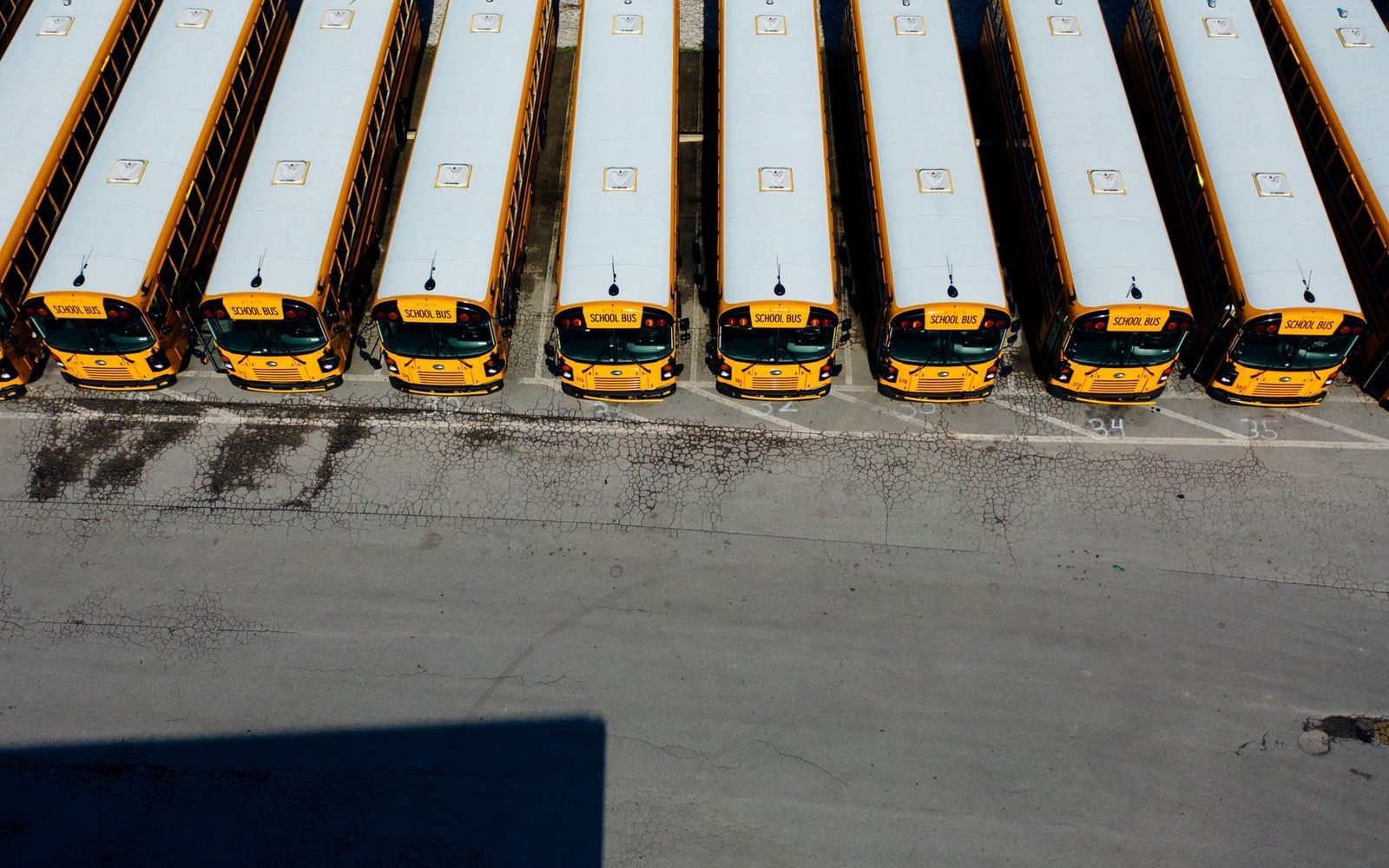
Frank W. Cyr’s national conference on school transportation, Teachers College, Columbia University, April 1939. It produced forty-four standards, one of which was a colour.
Photo: K / Pexels
The physical bus that emerged from the forty-four specifications was a recognisable type: flat-nose or conventional hood, black lettering on the yellow body, the words SCHOOL BUS in minimum-height letters front and rear, flashing warning lights, and a crossing arm — or its antecedent provision — to protect children stepping off. Door placement, aisle width, and seat spacing were fixed in the same document, giving bus-body manufacturers a common target for the first time.
Cyr, who later called himself "the father of the yellow school bus," had driven the process not from a regulatory office but from a land-grant-era instinct that rural children deserved the same access and safety as urban ones. The conference had no direct federal authority; its standards spread because states and manufacturers adopted them voluntarily, and within a decade the yellow bus was so uniform across the country that it functioned as a legal signal — many states eventually wrote the colour into statute.
The specifications have been updated since 1939, but the National School Bus Glossy Yellow has not changed. Every bus on every American road carries that original Teachers College decision forward, season after season, into the dark.