What the Chronology Covers
Boston Latin School opened in 1635, the first formal institution of public instruction in the English-speaking colonies. The Every Student Succeeds Act was signed in December 2015. Between those two points lies a span of three hundred and eighty years, but the site's scope is more particular: it traces how American public education was constructed from roughly the common school era of the 1830s through the federal accountability era that closed in 2015, with selected antecedents reaching back to the colonial and early-republic foundations that made the later construction possible.
The materials of that construction are heterogeneous. They include legislation — the Northwest Ordinance of 1787, which reserved section sixteen of every township for schooling; the Morrill Acts of 1862 and 1890, which converted federal land into agricultural colleges; the Elementary and Secondary Education Act of 1965; Title IX of 1972; Public Law 94-142 in 1975; No Child Left Behind in 2001; and ESSA itself. They include buildings — the one-room schoolhouse scattered across every rural township, the Rosenwald schools built by Black communities across the South, Crow Island School in Winnetka, Little Rock Central High School. They include objects — the McGuffey Readers, the Palmer Method copybook, the yellow school bus, the overhead projector, the Scantron sheet, the Apple II. They include people whose influence on the built institution outlasted their lives, and ideas that changed what a school building was supposed to contain and who it was supposed to serve.

Frank W. Cyr’s national conference on school transportation, Teachers College, Columbia University, April 1939. It produced forty-four standards, one of which was a colour.
Photo: K / Pexels
Seven dates inside that span recur with unusual frequency. They are not the only significant dates; they are the pivot points — moments at which a change in law, practice, or interpretation sent the rest of the institution in a new direction.
The Seven Pivot Points
1787. The Northwest Ordinance is the foundational legal act of American public education before there was a federal government capable of passing education law. Its reservation of land for schooling embedded the principle that local communities held a public obligation to maintain schools. Almost every later argument about federal aid, local control, and educational funding traces a line back here.
1837. Horace Mann accepted appointment as secretary of the Massachusetts Board of Education — the first such office in the country — and began the twelve-year campaign of annual reports, Prussian study tours, and normal-school founding that established the common school as a replicable model. The institutional vocabulary of the American public school: the trained teacher, the graded classroom, the public tax base, the state supervision — these were assembled in the years Mann held that position.
1862. The first Morrill Act redirected federal land policy into higher education, establishing the template for land-grant colleges that served agriculture, engineering, and — critically, at the 1890 extension — the historically Black colleges and universities that formed the only available post-secondary infrastructure for most African American students for the following century.
Boston Latin School opened in 1635, the first formal institution of public instruction in the English-speaking colonies.
1907. William Wirt began reorganising the schools of Gary, Indiana, around what became the Gary Plan — a rotation of two pupil platoons through academic rooms, shops, auditoriums, and outdoor spaces so that every square foot of building remained in continuous use. The platoon school was the most widely discussed school-design idea in the United States for the next two decades, and it prompted a direct counter-reaction: the child-scaled, activity-centred classroom that reached its architectural peak at Crow Island School in 1940.
1954. Brown v. Board of Education consolidated five separate cases — from Topeka, Clarendon County, Prince Edward County, Wilmington, and Washington, D.C. — into a single unanimous ruling that legally segregated public schools were unconstitutional. The decision did not end segregation; it began the legal and political contest over ending it, a contest that ran through Little Rock in 1957, through busing fights in the 1970s, and continues in the courts today. Every article on this site that touches on who public schools were built for, and who was excluded from them, passes through 1954.
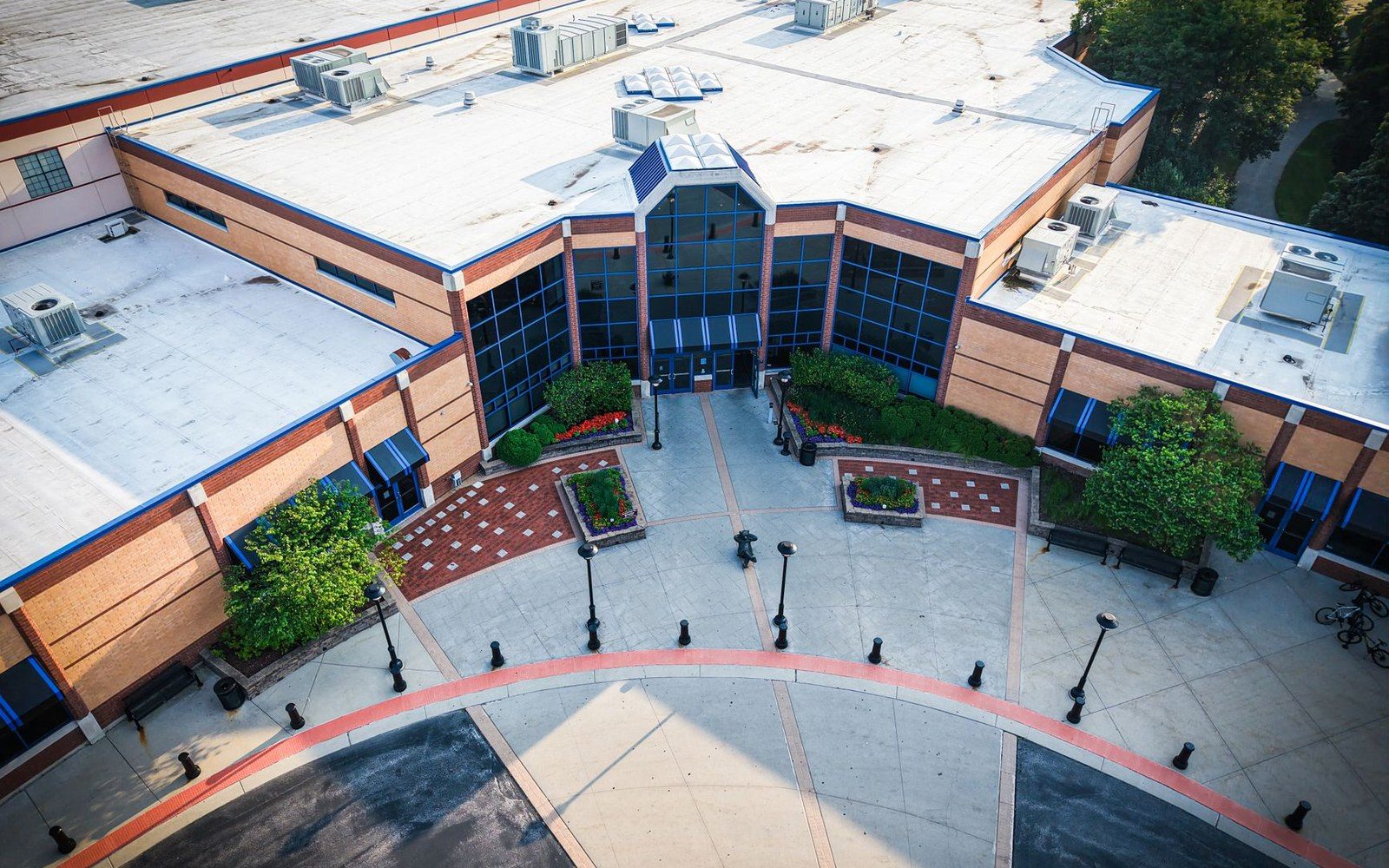
Low horizontal brick massing, and no monumental stair to climb.
Photo: Mushahid Shahid / Pexels
1965. The Elementary and Secondary Education Act introduced the first broad-based federal aid to public elementary and secondary schools. Title I — its largest provision, directing funds to schools serving concentrations of low-income children — created the federal accountability relationship that every subsequent reauthorisation, including No Child Left Behind and ESSA, either extended or revised. The ESEA also coincided with the National Defense Education Act's expansion of federal interest in curriculum, with the Voting Rights Act's reshaping of political access, and with the Great Society's broader redefinition of the federal role in domestic life.
1975. Public Law 94-142, the Education for All Handicapped Children Act, extended the equal-access logic of Brown to children with disabilities. It mandated a free appropriate public education for every child, regardless of disability, in the least restrictive environment, backed by an individualized education programme. Before 1975, an estimated one million children with disabilities were excluded from public schools entirely, according to congressional findings recorded in the act's legislative history. The 1975 date is where articles on school architecture, curriculum design, and federal law all converge.
Why Dates Rather Than Themes
A chronological index is not the same as a narrative argument, and this site does not make one. What the chronology does is establish sequence — which innovations preceded which constraints, which legal settlements enabled which building programmes, which objects arrived before the curricula to use them had been written. The yellow school bus's National School Transportation Standards, settled at a national conference at Teachers College, Columbia University, in 1939, preceded the federal highway system. The Scantron sheet arrived in 1972, before the accountability regimes that would make mass standardised testing a routine annual event. The Apple II reached California classrooms in 1982, years before any district had a coherent plan for what to do with it.
The site's full chronology runs from 1635 to 2015. The seven dates above are where the most threads cross. Readers who want to follow a single thread — one law, one building, one person, one object — will find that thread in the individual articles. This piece names the intersections.