The School Built in 1927
Central High, originally called Little Rock High School, opened in 1927 as a Gothic Revival building designed by a group of associated architects. What they produced was a monument to the ambitions of a Jim Crow school system. Little Rock maintained separate and systematically unequal facilities. Central High served white students; Dunbar High, with far less funding, served Black students. That hierarchy was structural, legal, and geographically encoded in the city's building stock. The beautiful building was also an instrument of exclusion.
Nine Days in September
The Supreme Court's 1954 ruling in Brown v. Board of Education required desegregation with deliberate speed. The Little Rock school board adopted a phased integration plan in 1955. By the summer of 1957, nine Black students — who became known nationally as the Little Rock Nine — had qualified to enroll at Central High for the fall term.
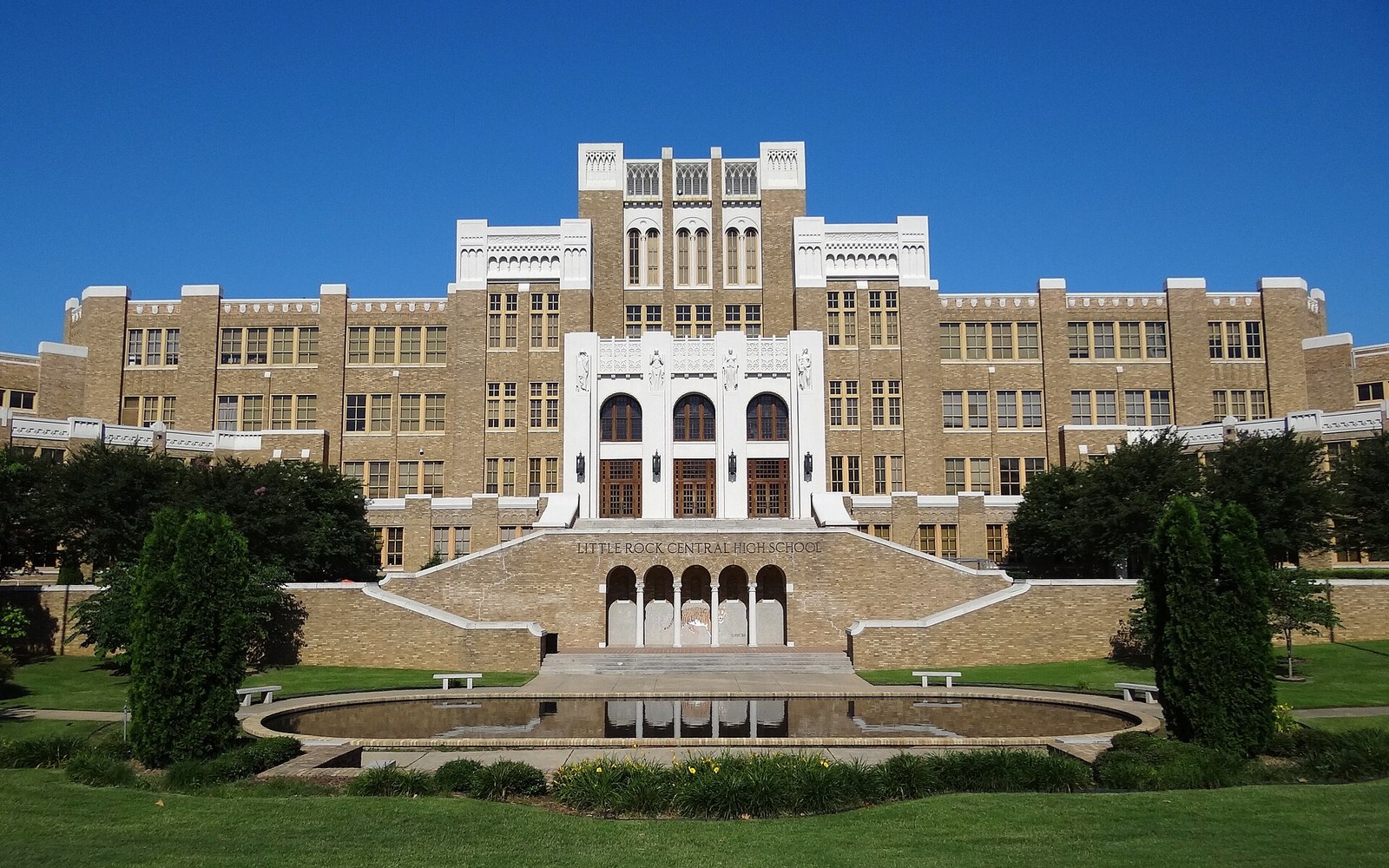
Opened 1927, a National Historic Site since 1998. The building is the document.
Photo: Facade of Central High School - Little Rock - Arkansas - USA - 01 · Wikimedia Commons
Arkansas Governor Orval Faubus ordered the Arkansas National Guard to surround the school building on September 2, 1957, one day before the school year opened, instructing the troops to prevent the nine students from entering. The justification offered was the maintenance of order; the federal district court found no credible evidence that a riot was imminent before the Guard was deployed. On September 4, the nine students attempted to enter, were turned away by armed soldiers, and faced a hostile crowd. Photographs of that morning circulated internationally.
President Dwight D. Eisenhower federalized the Arkansas National Guard and deployed the 101st Airborne Division to Little Rock on September 24. Soldiers escorted the nine students into the building the following morning. Federal troops remained on campus for the remainder of that school year. The crisis marked the first time since Reconstruction that a president had deployed federal military force to enforce civil rights in the South. The building itself — its wide front steps, its Gothic entrance — became the visual record of what resistance to a federal court order looked like.
Governor Faubus closed all four Little Rock public high schools for the 1958–59 school year rather than comply with desegregation. The closures affected more than three thousand students of both races. The Supreme Court ruled against the closure strategy in Cooper v. Aaron (1958), holding unanimously that states could not nullify federal constitutional rights and reaffirming that the Brown mandate bound state officials directly.
The Building as Federal Record
Central High School continued operating as a public school after reopening in 1959 and remains in use today as a functioning Little Rock public high school. In 1998, Congress established the Little Rock Central High School National Historic Site, administered by the National Park Service, immediately adjacent to the school. The NPS visitor center occupies the building across the street that was once a Mobil gas station — a deliberate choice: the site preserves context, not just architecture.
Central High, originally called Little Rock High School, opened in 1927 as a Gothic Revival building designed by a group of associated architects. What they produced was a monument to the ambitions of a Jim Crow school system.
The building carries two designations simultaneously: it is a National Historic Landmark, recognized for its architectural significance, and a National Historic Site, recognized for the constitutional events of September 1957. The architecture that American School Board Journal praised in 1927 is now inseparable from the legal record it framed. Every carved stone course and every Gothic arch is indexed, in the federal record, to nine students, a surrounding Guard, and the deployment of an airborne division to enforce a court's order that a state refused to obey.
The building did not change. The case file that attached to it changed what the building means.